Eye condition
Age-related macular degeneration damages the macula, the central part of the retina that gives you sharp, straight-ahead vision. It is a leading cause of vision loss in Australians over 50, and it comes in two forms, dry and wet AMD. It rarely affects your side vision, so it does not usually cause complete blindness.
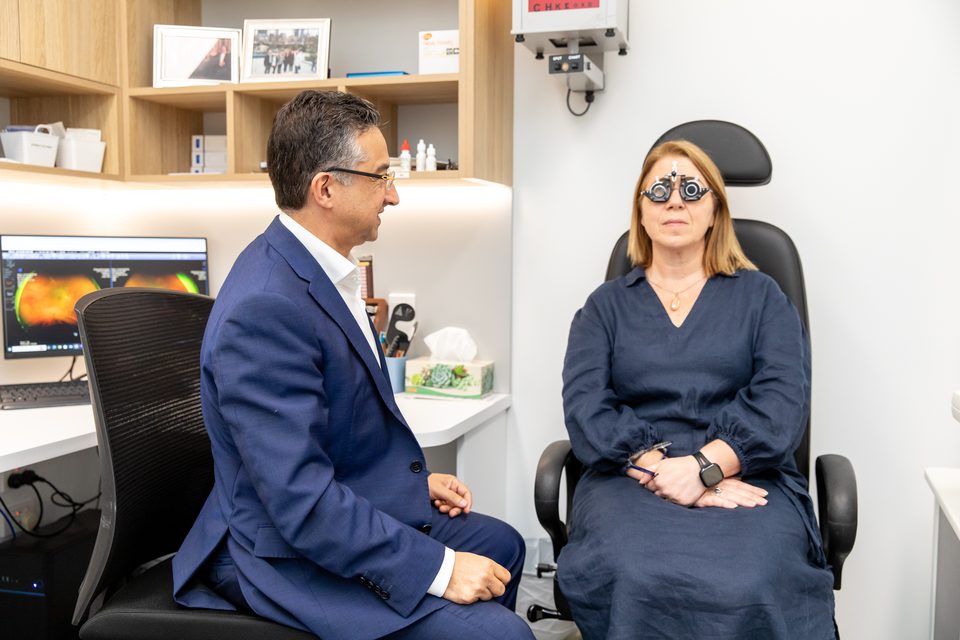
Early signs often include blurring or a wavy and distorted patch in the central vision, which is frequently noticed when reading or recognising faces
The condition develops as either dry or wet AMD, with each form progressing at a different speed and needing its own management approach
The disease is common in people over 50, with the Macular Disease Foundation Australia reporting that around 1.5 million Australians show some signs of the condition
Regular eye examinations are essential for early detection, because the disease is usually painless and can easily go unnoticed in its early stages
Treatment focuses on protecting sight, with intravitreal anti-VEGF therapy commonly used for wet AMD to help slow the progression of vision loss
A diagnosis can feel frightening when it affects the vision you rely on for reading, recognising faces, and driving. We understand that worry. This page explains what AMD is, how dry and wet AMD differ, the symptoms to watch for, how we diagnose it, and the care we provide.
The macula is a small area at the centre of your retina, the light-sensitive layer at the back of your eye. It gives you the fine, detailed vision you use to read or to see a face clearly. AMD develops when this central area gradually breaks down with age.
Because AMD affects the centre rather than the edges of your sight, detailed tasks such as reading become harder over time, while many people continue to move around independently. It is not painful, and in its early stages it often causes no noticeable change, which is why regular eye checks matter so much.
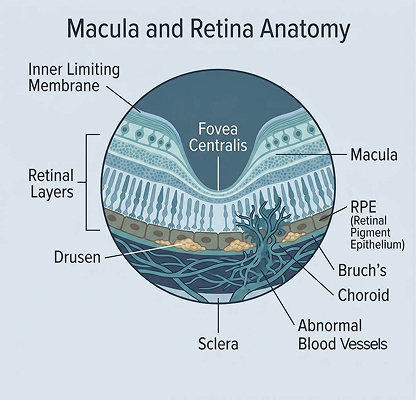
AMD takes two main forms, dry and wet, and they behave quite differently. Understanding which type you have helps explain what to expect.
Dry AMD is the more common form. It develops slowly as the cells of the macula thin and break down. Small yellow deposits called drusen often build up under the retina, and over time the central vision becomes less sharp. It can also shift towards the wet form, which is why ongoing review matters.
Wet AMD is less common but more serious. It happens when abnormal blood vessels grow beneath the retina, a process called choroidal neovascularisation. These vessels can leak fluid or blood, and vision can change quickly, sometimes within days. This speed is why early referral matters, and how we treat it is covered below.
The most common AMD symptoms affect the centre of your vision. These changes can be subtle at first, so it helps to know the signs.
One sign deserves particular attention. Sudden new distortion, where straight lines suddenly look bent or wavy, or a new dark patch in your central vision, can indicate wet AMD developing and needs prompt assessment. See When to Seek Help Promptly below.
An Amsler grid is a simple square pattern of straight lines with a dot in the centre. Looking at it one eye at a time, with your reading glasses on, lets you check whether any lines appear wavy, broken, or missing.
Macular Disease Foundation Australia (opens in a new tab) provides a grid and self-monitoring instructions. It does not replace professional review, but it can help you notice a change early.
Several factors raise the risk of developing AMD. Some you cannot change, and some you can influence.
Knowing your risk does not mean AMD is inevitable. It means regular eye checks and healthy habits are worth prioritising, especially if AMD runs in your family. The Better Health Channel (opens in a new tab) offers further reading on macular degeneration and eye health.
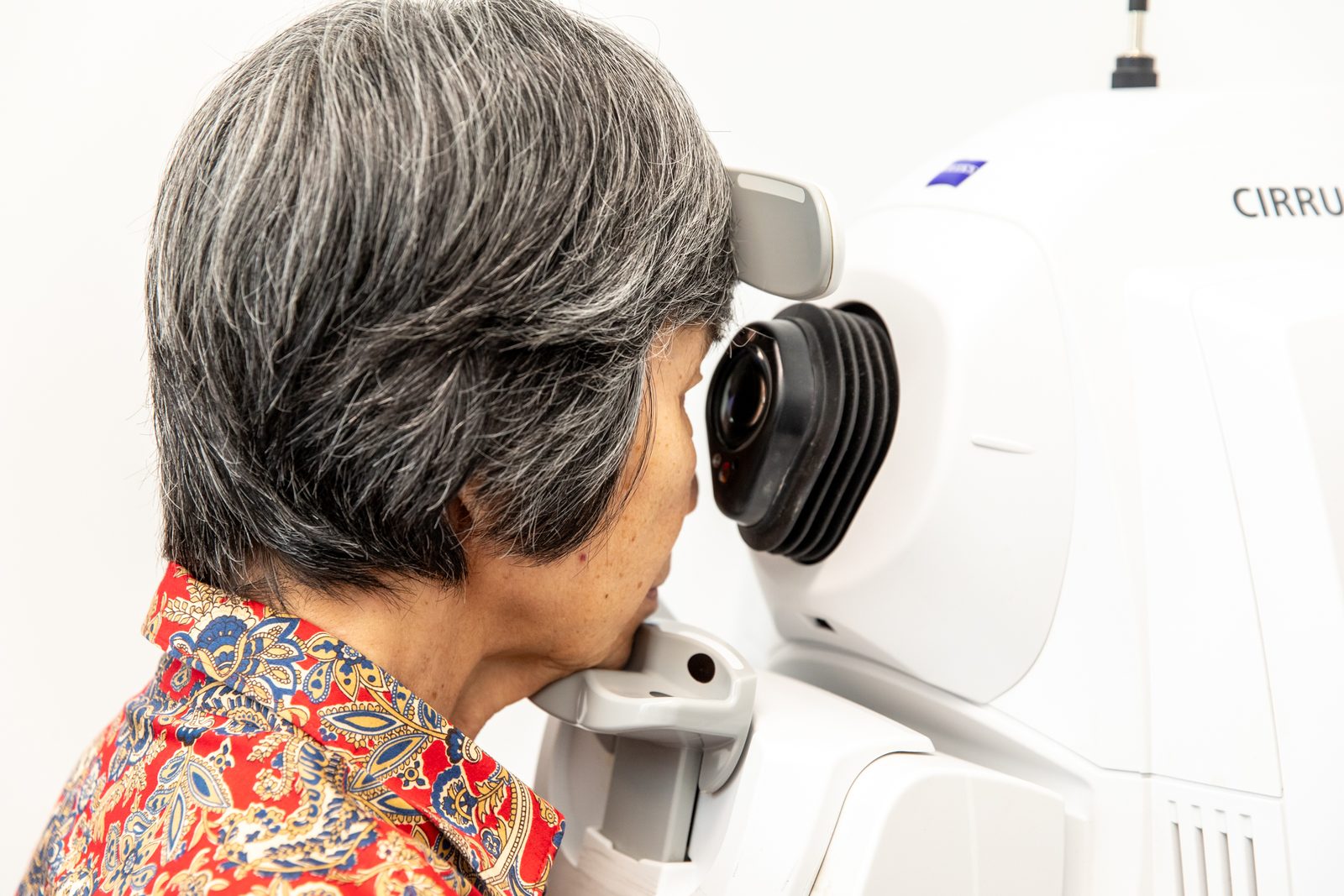
Diagnosing AMD usually begins with your optometrist, who may detect early changes during a routine eye examination and refer you on. Your specialist then confirms the diagnosis and which form of AMD is present.
The main investigation is optical coherence tomography (OCT), a quick scan that produces detailed cross-section images of the retina without touching the eye. OCT shows the layers of the macula, any fluid, and any thinning, and is also used to monitor AMD.
In some cases, fluorescein angiography is used. A dye highlights the blood vessels in the retina, helping to identify the abnormal vessels seen in wet AMD. Your specialist will explain which tests you need.
Treatment for AMD depends on the type. No single approach suits everyone, so we plan your care around your diagnosis and your eyes.

For wet AMD, the main treatment is anti-VEGF therapy, an injection of medicine into the vitreous cavity to reduce the growth and leakage of the abnormal blood vessels. Treatment aims to slow or halt vision loss and, for many patients, helps preserve remaining vision, though results vary from person to person.
Treatment usually begins with a series of injections, often monthly at first. The frequency may reduce over time depending on how your eye responds.
The injection is given after anaesthetic eye drops, using a very fine needle, and most patients report minimal discomfort.
You can read more on our Intravitreal Injections page.
For dry AMD, no treatment currently reverses the condition, so care focuses on supporting your eye health and watching for change over time.
Some patients with certain stages of dry AMD are advised about nutritional supplements formulated for macular health, based on large clinical studies of eye vitamins. These are not suitable for everyone and are not a cure, so whether they may help you is a decision for your specialist.
Lifestyle measures support general eye health and are widely recommended:
Ongoing monitoring is the cornerstone of dry AMD care, because the condition can change gradually and quietly. A consistent review schedule helps us spot any change while there is still an opportunity to act.
Monitoring usually combines OCT scans at intervals recommended by your specialist with regular self-monitoring at home using your Amsler grid.

Our medical retina specialists provide ongoing, individualised care for people with AMD. It is not a one-off problem to be fixed and forgotten. It is a condition we manage with you over time.
When you are referred to us, your specialist assesses the type and stage of your AMD, explains what it means for your vision, and discusses the options that are realistic for you.
Your care is led by Dr Dov Hersh and Dr Mark Gorbatov.
If treatment is appropriate, we set up a review schedule suited to your needs and keep your GP or optometrist informed of your progress.
Because AMD often involves regular visits, we aim to make each one clear and reassuring.
Common questions about AMD are answered below. Your specialist can give you guidance specific to your eyes at consultation.
There is currently no cure for AMD. The aim of care is to protect the vision you have, through the treatment and monitoring approaches set out above.
AMD usually affects central vision while leaving your peripheral, or side, vision intact, so it does not typically cause complete blindness.
Many people continue with daily life, though detailed tasks such as reading may become harder.
Your specialist sets and reviews the injection schedule based on how your eye responds, so the frequency is tailored to you rather than fixed.
Yes, the condition can run in families. If a close relative has AMD, mention this to your optometrist so your eye checks can take it into account.
Sudden changes in your central vision warrant prompt assessment. If you notice sudden distortion, a new dark patch in your central vision, or any sudden change in either eye, please contact your optometrist, GP, or our rooms promptly, as quick assessment matters most with wet AMD.
To arrange specialist assessment, contact us to book an appointment, and see our New Patients page for what to bring and how to prepare.
For a related condition, you may also find our Diabetic Eye Disease page helpful.
The pages below cover the treatment and the specialist most often involved in macular degeneration care at Eastwood Eye Surgery, and the related retinal condition mentioned above.
The anti-VEGF injections used to treat wet AMD, what the appointment involves and how the schedule is set.
Eye conditionA related condition affecting the retina, managed by the same medical retina specialists and often treated with the same injections.
Your surgeonOne of the two medical retina specialists who lead macular degeneration care at the practice.
Further patient information:
RANZCO Eye Conditions (opens in a new tab) AAO What Is Macular Degeneration? (opens in a new tab)With wet AMD in particular, a sudden change in your central vision is worth acting on quickly. Ask your optometrist or GP for a referral, then get in touch.
This information is general in nature and is not a substitute for personalised medical advice. Please speak with your ophthalmologist about your individual circumstances.