Eye condition
Eye floaters and flashes are very common and are usually caused by harmless age-related changes inside the eye. The warning sign that matters is a sudden change, such as a shower of new floaters, persistent flashes, or a shadow across your vision, which can point to a retinal tear or detachment that needs prompt assessment. If you have these urgent symptoms, please read the urgent section below and seek same-day care.

Floaters become increasingly common from around the age of 45, and most people will develop some during their lifetime.
The usual cause is a shrinking of the vitreous gel known as posterior vitreous detachment, where the gel slowly separates from the retina with age.
Red flags that require immediate action include a sudden shower of new floaters, recurring flashes of light, a dark curtain appearing across part of the vision or an abrupt drop in eyesight.
Timing is critical because a retinal tear can often be successfully sealed with laser treatment if detected early and before it progresses to a full detachment.
Eye floaters are small shapes that drift across your field of vision, such as dots, strands, cobwebs, or faint shadows. They are caused by tiny particles within the vitreous, the clear gel that fills the eye. As light passes through, these particles cast small shadows on the retina, and you see them as floaters.
Floaters tend to move when you move your eyes, and they often dart away when you try to look at them directly. They are usually most noticeable against a bright, plain background, such as a clear sky or a white wall.
Floaters are a normal part of how the eye ages. In most cases they are not a cause for concern, but a new or sudden change is worth having checked.
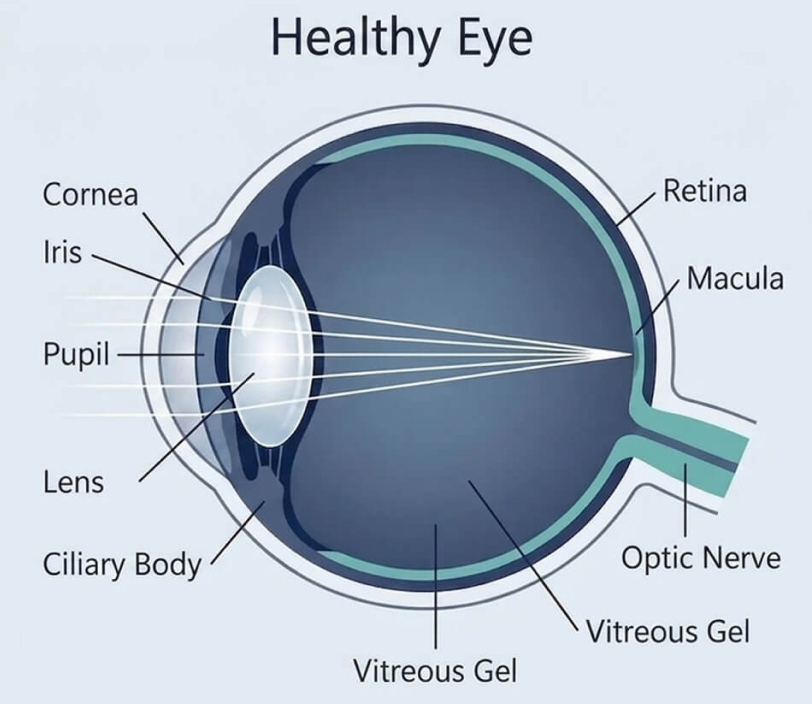
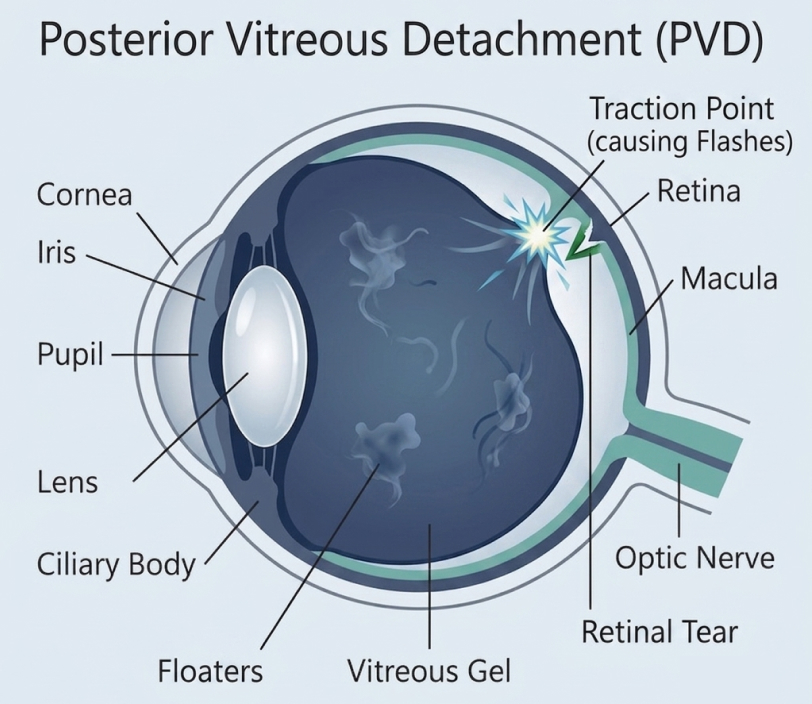
Floaters have several causes. The most common is a natural age-related change in the vitreous gel. The others, while less common, are why a new or changing floater deserves a proper look.
Posterior vitreous detachment (PVD) is the most common cause of new floaters in adults over 50. With age, the vitreous gel shrinks and gradually separates from the retina at the back of the eye. This is a normal process that happens to most people at some stage.
As the vitreous separates, you may suddenly notice new floaters, and sometimes brief flashes of light. In most people, a PVD settles on its own and causes no lasting harm. Even so, a new PVD should be checked, because the separating gel can occasionally pull hard enough to damage the retina.
A retinal tear is the change that matters most. As the vitreous pulls away, it can occasionally tear the retina. A tear occurs in a small proportion of people who develop symptomatic PVD, so it is uncommon, but it matters because a tear can progress to a retinal detachment if it is not treated. The urgent symptoms that can signal a tear are listed below.
You can read more in our retinal conditions guide.
Less common causes also exist. Floaters can be linked to inflammation inside the eye (uveitis) and to bleeding into the vitreous (vitreous haemorrhage), which can be associated with diabetic eye disease. This is another reason that new or changing floaters deserve a proper examination.
Flashes of light, known medically as photopsia, are brief sparks or streaks of light, often seen towards the edge of your vision. They may look like a camera flash or a flicker of lightning, and they are usually more obvious in dim surroundings.
Flashes are most often caused by the vitreous gel tugging on the retina, which can happen as a posterior vitreous detachment develops. The retina responds to this pulling by sending a light signal to the brain, which you experience as a flash.
In many cases, flashes settle over a few weeks as the vitreous finishes separating and the traction eases. New flashes that arrive with new floaters are one of the warning signs covered in the urgent section below.
Most floaters and flashes are harmless, but a small number signal a retinal tear or detachment. Seek urgent assessment, the same day where possible, if you notice any of the following signs.
These symptoms may indicate a retinal tear or detachment, conditions that need prompt treatment to help prevent permanent vision loss. Please contact us or your referring doctor without delay, and do not wait for a routine appointment.
These warnings are about your safety, not about pressure. We would rather see you for a check that turns out to be nothing than miss a tear that could have been treated.
You can read more about how a detached retina is treated on our retinal surgery page.
Floaters become less noticeable for most people over time, as the brain gradually learns to filter them out. Over weeks to months they often fade into the background, even though the particles themselves remain in the eye. Floaters do not usually disappear completely, but they tend to bother you less.
The large majority of floaters need no treatment at all. Once a specialist has confirmed the retina is healthy, reassurance and monitoring are usually all that is required.
A surgical procedure to remove floaters (a vitrectomy) does exist, but it carries real risks and is not a routine treatment. It would only ever be considered in exceptional circumstances, after a thorough specialist assessment has weighed the potential benefit against those risks. For most patients, this is not recommended.

When you are referred to us with new floaters or flashes, our priority is to check that your retina is healthy. We take the time to understand when your symptoms began and how they have changed, because that history helps guide the examination. Your assessment usually includes:
Dilating drops temporarily blur your vision and make your eyes more sensitive to light, so please arrange for someone else to drive you home after your appointment.
If no retinal tear is found, we will explain your results and give you a clear guide to the symptoms that should prompt you to return. We will also arrange any monitoring you need.
If a retinal tear is found, treatment may involve laser to seal the tear, or referral for retinal surgery if a detachment has developed.
You can learn more in our retinal conditions guide and on our retinal surgery page.
Your assessment is carried out by our specialist ophthalmologists, including members of our retina team. Outcomes depend on your individual situation, and your surgeon will discuss what is realistic for you at your appointment.
Common questions about floaters and flashes are answered below. Your specialist can give you guidance specific to your eyes at consultation.
It depends on your symptoms. A shadow or curtain across your vision, or a sudden loss of vision, means emergency eye care straight away, while new floaters on their own, with none of the warning signs above, can be checked through an urgent same-day appointment with an optometrist or ophthalmologist rather than an emergency department.
Many people drive comfortably with long-standing floaters once their eyes have been checked and the floaters have settled into the background. If floaters are new, or significantly affect your vision, have your eyes assessed and seek advice from your eye specialist before driving.
The pages below cover the retinal conditions that new floaters and flashes can point to, the surgery used to repair them, and the other disease that can bleed into the vitreous.
Retinal detachment, vein occlusion, macular hole, epiretinal membrane and uveitis, including what a tear looks like once it progresses.
TreatmentThe laser, freezing and vitrectomy procedures used to seal a retinal tear and to reattach a retina that has already detached.
Eye conditionHow diabetes damages the retinal blood vessels, and why bleeding into the vitreous is one of the less common causes of new floaters.
Further patient information:
RANZCO Floaters and Flashes (opens in a new tab) AAO Floaters and Flashes (opens in a new tab)Contact us today and we will arrange a prompt assessment of your retina. New patients can find out what to expect on our new patients page.
This information is general in nature and is not a substitute for personalised medical advice. Please speak with your ophthalmologist about your individual circumstances.